
Halpern Iteration Achieves Õ(ε−1/p) pth-Order Oracle Complexity for Monotone Variational Inequalities
arXiv:2608.08463v1
arXiv:2608.08463v1
arXiv:2609.09740v2
Research manuscript · PDF
Research manuscript · PDF
Research manuscript · PDF
Apex Intelligence’s automated research system (referred to below as Apex’s AI system) has worked with researchers on five mathematical projects spanning optimization, harmonic analysis, symbolic dynamics, low-dimensional topology, and knot theory.
The first two results have been reviewed by their authors and collaborating mathematicians. The remaining three manuscripts present proposed proofs whose conclusions remain subject to independent verification. These include a proposed proof of a convex strengthening of Nivat’s conjecture, a problem dating to 1997.
Together, the projects illustrate different ways AI can contribute to mathematical research: connecting established methods, developing new representations, and constructing arguments for unresolved questions. Their mathematical standing depends on the validity of their proofs, with the scope of verification distinguished below.
| Project | Status in this announcement | What the manuscript reports |
|---|---|---|
| Monotone variational inequality algorithms | Reviewed by authors/collaborating mathematicians | A higher-order route combining Halpern iteration and an anchored tensor solver. |
| Mockenhaupt's three-term conjecture | Reviewed by authors/collaborating mathematicians | A uniform analytic proof covering the previously open parameter range. |
| Convex Nivat conjecture | Candidate argument; independent review invited | A proposed proof for every finite lattice-convex window. |
| Souto's question in genus two | Candidate argument; independent review invited | A proposed proof that is contractible. |
| Complex of incompressible Seifert surfaces | Candidate argument; independent review invited | A proposed proof that is contractible for nontrivial knots. |
Why do selfish route choices produce traffic jams? Where will competing firms' prices settle? What happens when several AI objectives are optimized against one another? These settings all involve equilibria: a participant's best choice depends on the choices of others.
A common mathematical framework is a monotone variational inequality. Given a monotone operator and a compact convex set , we seek such that
When for a differentiable convex function , a solution minimizes on . In an appropriately structured game, the operator may be the players' pseudo-gradient, and a solution corresponds to an equilibrium. Faster methods for these problems can also inform minimax optimization and some adversarial learning settings.
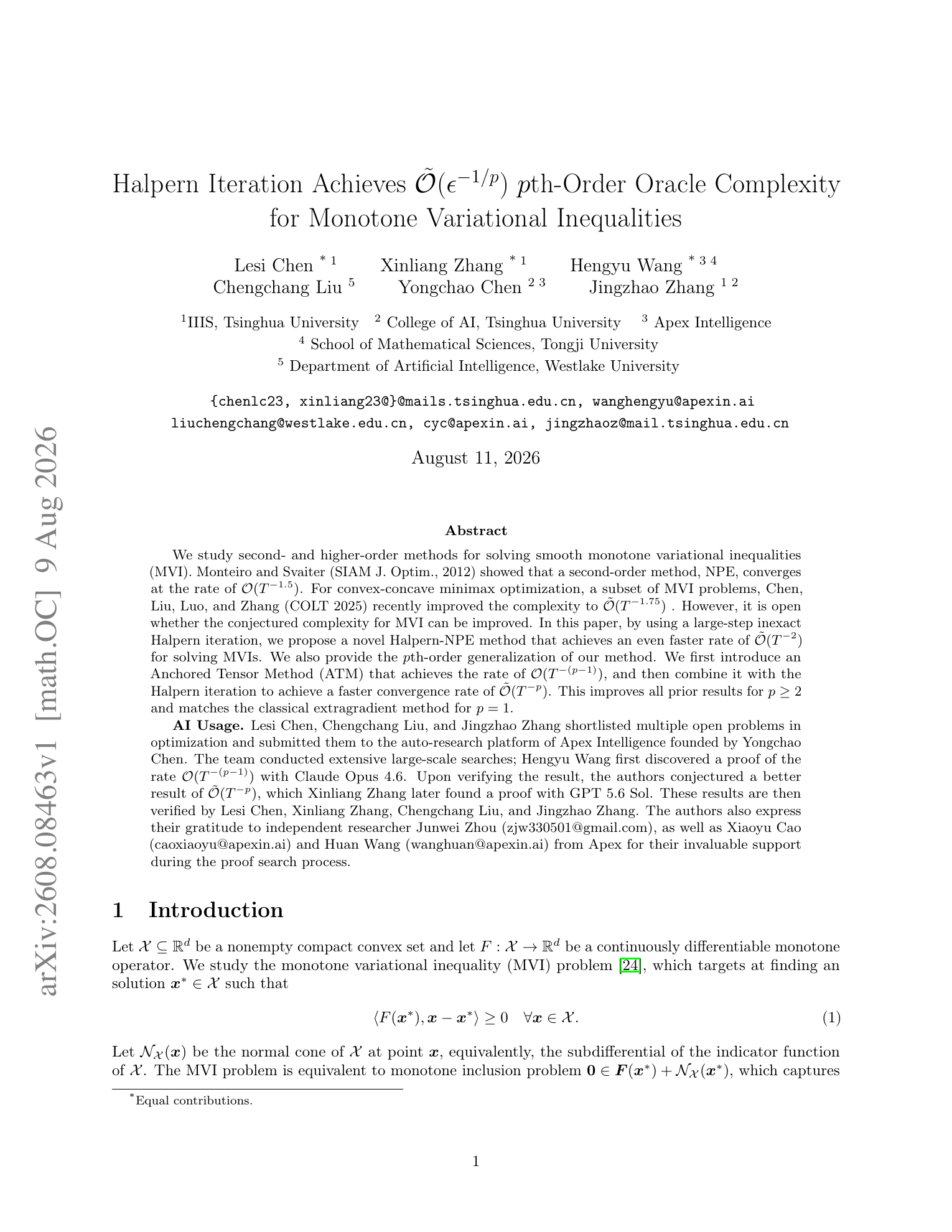
In work with mathematicians at Tsinghua University, Apex's AI system explored a connection between Halpern iteration, introduced in 1967, and higher-order methods for monotone variational inequalities. The resulting paper introduces an Anchored Tensor Method (ATM) as an inner solver and combines it with a large-step inexact Halpern iteration. It reports th-order oracle complexity for a specified residual criterion, improving the earlier bound in that setting.
Subsequent papers by independent teams developed optimal high-order results. In particular, the reported accuracy exponent improved to
under their stated oracle models and assumptions. The distinction matters: this later bound is not the bound proved in Apex's initial paper. The broader story is the use of anchoring to open a line of high-order algorithm design, followed by further work that sharpened the guarantees.
Paper: https://arxiv.org/abs/2608.08463
What happens to a function's size if we change the sign of just one Fourier coefficient? The Hardy–Littlewood majorant problem asks whether coefficientwise domination in absolute value forces domination of norms.
Let and . For trigonometric polynomials
with and , must ? The answer is yes for positive even integers , by expanding the even power and using Fourier orthogonality. For other , the majorant property can fail.
Mockenhaupt's three-term conjecture asks for the sharp, minimal example. For every integer , define
The conjecture states that, whenever ,
The coefficients have identical absolute values; changing one sign makes the norm strictly larger. Two terms cannot give the same phenomenon: after a frequency shift, a two-term polynomial is of the form , and changing its relative sign amounts to translating .
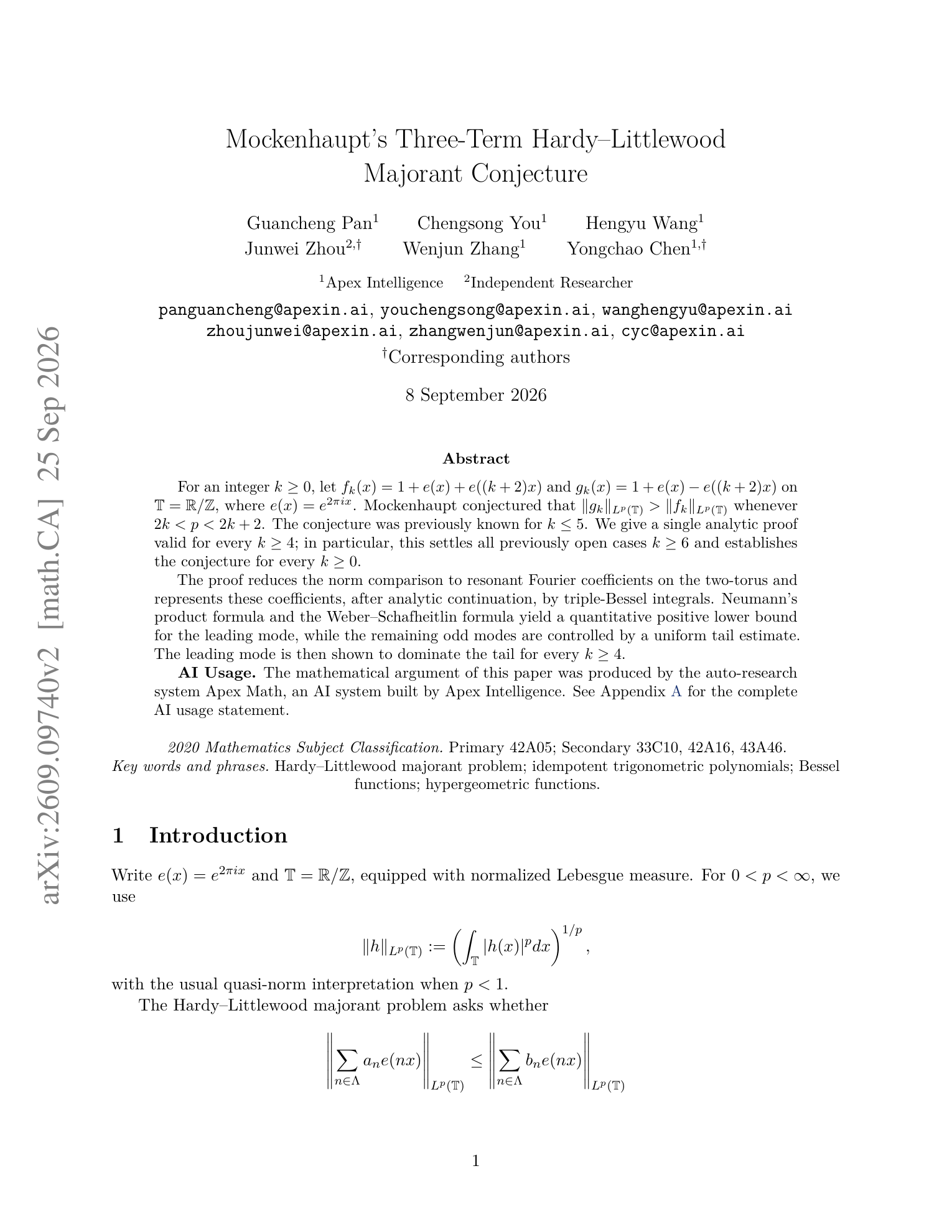
The cases were previously known. The paper reports a single analytic proof for every , settling all previously open cases . Its central move is to recast a one-dimensional norm comparison as a problem about resonant Fourier modes on the two-torus. After representing the coefficients through triple-Bessel integrals, the argument derives a positive lower bound for the leading mode and a uniform estimate for the remaining odd modes; the leading term dominates the tail.
According to the paper's AI-use statement, Apex's AI system produced the mathematical argument. The authors subsequently checked it section by section and take responsibility for the final manuscript. The proof has not been formalized in Lean or another theorem prover.
Paper: https://arxiv.org/abs/2609.09740
The Morse–Hedlund theorem links low pattern complexity in a bi-infinite word to periodicity. Nivat's 1997 question asks whether an analogous statement holds in two dimensions: if a configuration over a finite alphabet has at most distinct patterns in some rectangular window, must it have a nonzero period?
Write for the number of distinct such patterns. The original question is whether
The submitted manuscript proposes a stronger convex statement. For a nonempty finite lattice-convex window , where , define
It claims that for some such implies that is periodic. Rectangles are special cases, so if the proposed convex proof is valid, it would also settle the original rectangular conjecture. Earlier work of Kari and Szabados developed an annihilator and periodic-decomposition framework and established an asymptotic version; it did not settle the full rectangular conjecture.
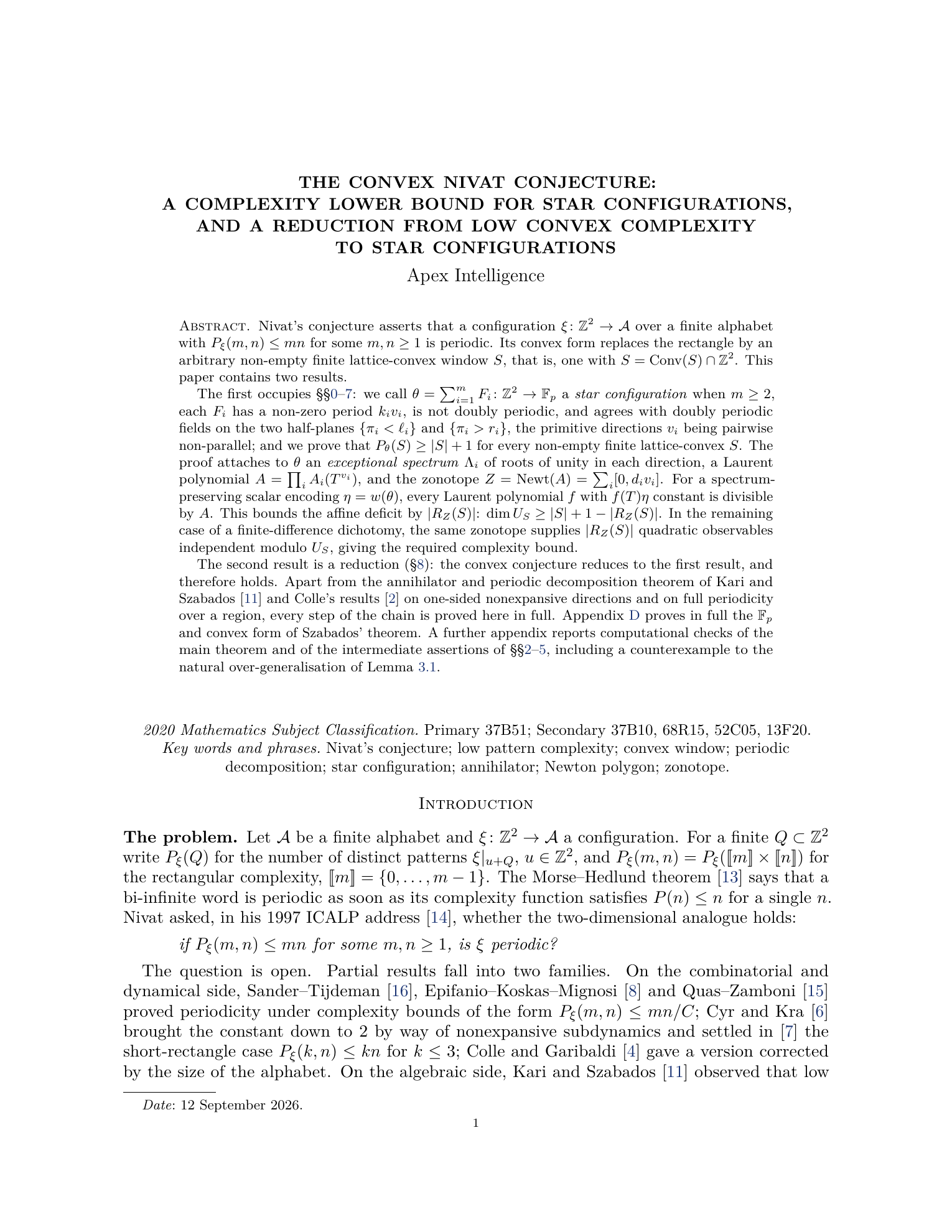
The paper's strategy connects an algebraic result on star configurations—involving Laurent polynomials, annihilator ideals, and zonotopes—to a dynamical reduction using orbit closures and periodicity on regions. Its Theorem A asserts for star configurations; the later reduction aims to turn any counterexample to the convex conjecture into such a configuration.
The argument cites established results by Kari–Szabados and Colle as inputs. The team also reports a companion Lean 4 project of approximately 36,000 lines that compiles with no sorry; according to the team, the regional theorem drawn from Colle is explicitly marked as an external assumption in that formalization and work to formalize it continues. A clean compilation does not by itself remove an external axiom or constitute independent validation of the full result. The manuscript and code are being released for detailed review.
Paper: nivat.pdf
On a closed orientable surface of genus , the classical curve complex has vertices given by isotopy classes of essential simple closed curves; a set spans a simplex when its members can be represented by pairwise disjoint curves. In , the condition is relaxed to pairwise geometric intersection number at most one.
Souto observed that the inclusion is null-homotopic and asked whether , or some more permissive , is contractible. The newly released manuscript claims an affirmative answer for genus two:
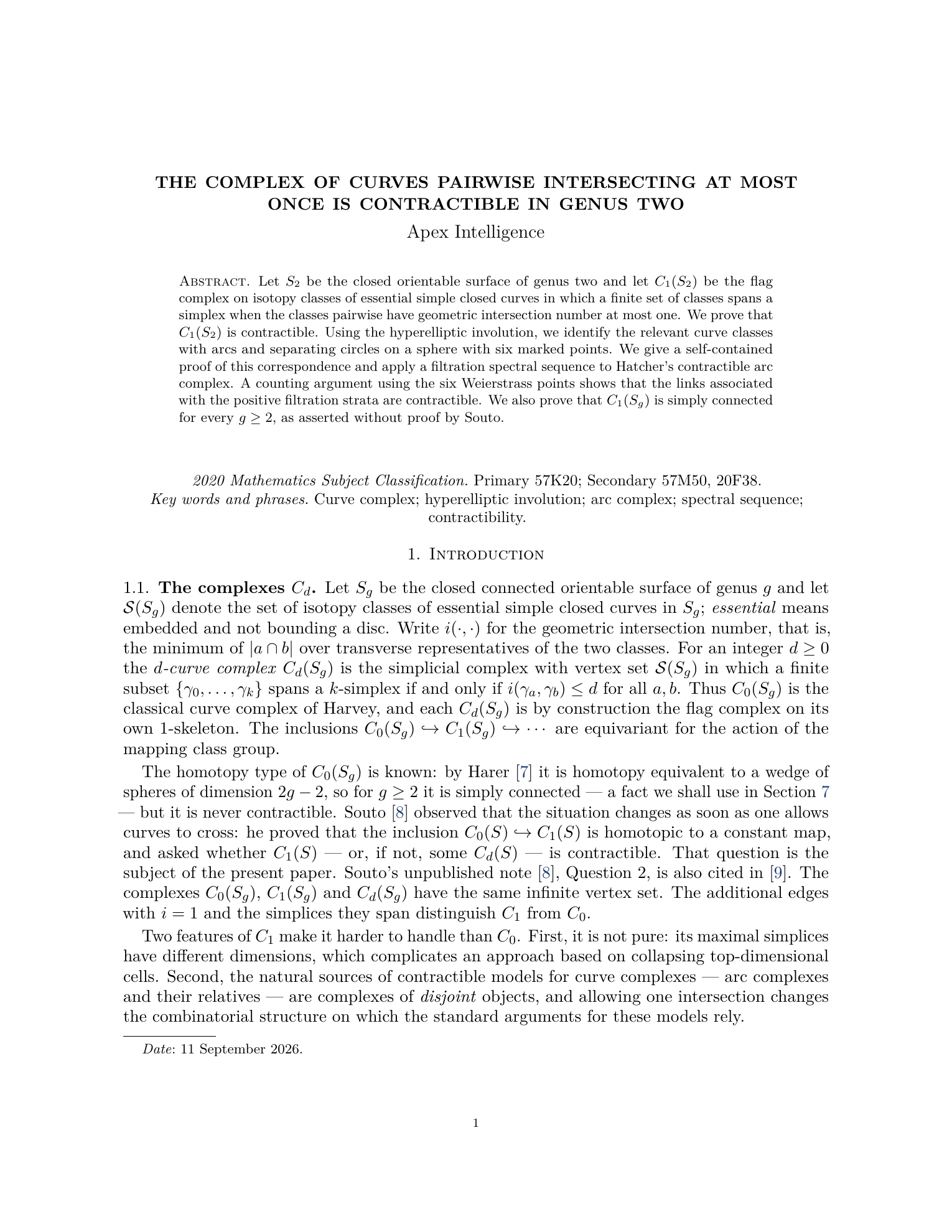
It uses the hyperelliptic involution to translate the genus-two problem to an arc complex on a sphere with six marked points, then applies a filtration and spectral-sequence argument. The manuscript also proves for every and gives a self-contained version of the required correspondence between genus-two curves and arcs or separating circles on the marked sphere. It identifies why the six-point argument does not directly extend to larger genus.
These are claims of a candidate proof. Apex invites mathematicians to inspect the curve-to-arc correspondence, intersection formula, and spectral-sequence steps independently.
Paper: souto-g2.pdf
Let be a nontrivial knot and its exterior. A Seifert surface is a compact, connected, orientable surface properly embedded in whose boundary is a longitude of . It is incompressible when the inclusion induces an injective map on fundamental groups.
Kakimizu's complex has these surfaces' ambient isotopy classes as vertices. A finite collection spans a simplex if the classes admit simultaneously pairwise disjoint representatives. The full subcomplex is spanned by the minimal-genus classes. Kakimizu established connectedness; Schultens proved simple connectivity of ; and Przytycki and Schultens proved contractibility of while explicitly asking whether the entire is contractible.
The newly released manuscript claims:
Its methodological shift is to replace the search for a globally well-defined projection with an exchange-complex criterion: at each relevant step, one proves that a lower-complexity exchanging vertex exists, without prescribing a compatible global choice. The paper states a combinatorial theorem for nonempty connected flag exchange complexes and applies it using three-dimensional geometric arguments. It also claims contractibility for genus truncations when and, under a stated linking condition, a class of links.
The proof includes a fixed-boundary area-attainment argument and cites a universal-disjointness result as an external geometric input. The full chain still calls for independent expert verification.
Paper: kakimizu.pdf
“I reviewed two mathematical papers provided by Apex. Compared with my experience using other AI tools directly, they show clear improvement in structure and organization. One paper's overview of its central idea was particularly clear and helped me grasp the proof's framework quickly. This showed me AI's potential to assist mathematical research and organize technical writing. Of course, I have not verified every proof step in either paper. The manuscripts would benefit from shorter presentations, fuller references, and necessary diagrams. Mathematical research requires more than obtaining a result: colleagues also need to understand where it comes from and why its key steps work. I look forward to Apex continuing to improve in these respects and helping researchers explore, check, and communicate mathematical ideas more effectively.”
“A research platform can produce highly imaginative algorithms that differ from our usual expectations. It has also improved results for a fundamental problem such as minimax optimization. An interesting research direction is to identify the limits of the model's capabilities and ask whether a few principles can characterize them.”
— Comments from mathematics researchers. These observations are not substitutes for independent proof verification.