
Apex Intelligence is releasing 36 research results produced by its autonomous AI research system. The release is designed for researchers to read, review, reproduce, and discuss—not just as a set of papers, but as a traceable record of how each project moved from a scientific question to experiments and validation.
What we built
The system is built to carry scientific work end to end with minimal human intervention. Across these projects it performed literature review, method design, code implementation, experimental analysis, figure plotting, LaTeX paper writing, self-review, and iterative optimization. Human involvement was limited and non-expert.
The goal is not paper generation alone. It is research that can be tested, audited, reproduced, and extended by the community.
Two directions, six research areas
Thirty-three outputs focus on AI research, while three focus on robotics and embodied intelligence. The AI work is organized into five areas:
- 11 outputs: model evaluation, benchmarks, and data quality.
- 8 outputs: information extraction, causal inference, and symbolic reasoning.
- 4 outputs: AI agents, reinforcement learning, and code repair.
- 5 outputs: LLM safety and alignment.
- 5 outputs: model mechanisms, training, and inference efficiency.
- 3 outputs: embodied intelligence and Vision-Language-Action models.
Five representative studies
The release highlights five studies that show the range of questions the system can formulate, test, and refine. Their manuscripts, code, experiments, generation traces, and validation records are collected in the highlighted papers repository.
01 · Tracing AI-generated content through recursive generation
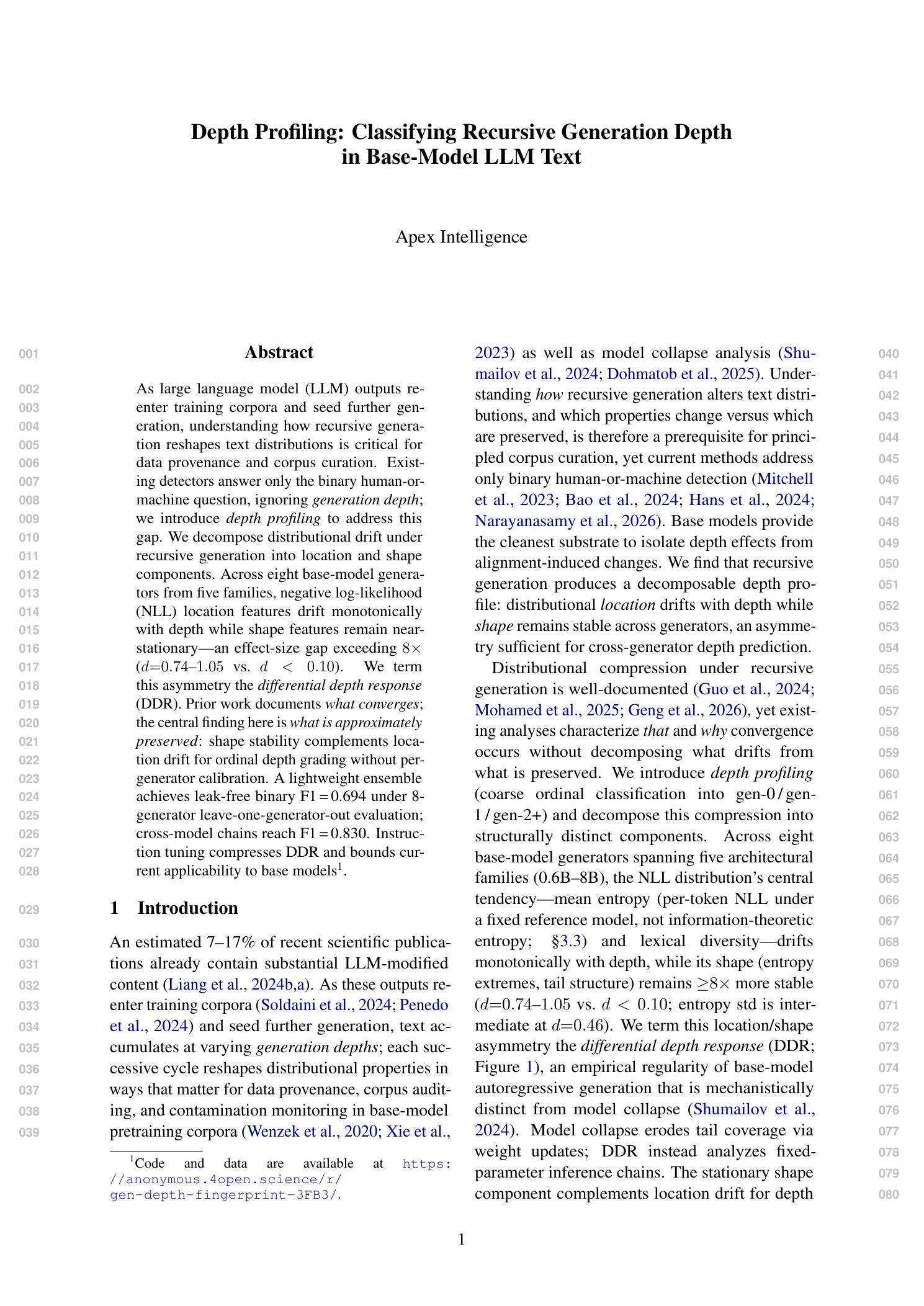
Depth Profiling: Classifying Recursive Generation Depth in Base-Model LLM Text asks how statistical distributions evolve when text passes through repeated rounds of LLM generation, and whether those changes can reveal the number of generations a text has undergone. Instead of treating detection as a Human-vs-AI binary task, it introduces Generation Depth Profiling: estimating whether a sample is original text, one generation removed, or the product of deeper recursive generation.
The study uses eight base LLMs from five model families and approximately 37,000 multi-round samples. It computes token-level negative log-likelihood distributions with a fixed reference model, then combines those signals with statistical and lexical-diversity features to track how text changes across generation depth.
The analysis identifies a Differential Depth Response (DDR): location features such as mean NLL drift continuously across rounds, while some distribution-shape and extreme-value features remain comparatively stable. The changing features show effect sizes of approximately d = 0.74–1.05, while several stable features remain below 0.10. A lightweight classifier built on this asymmetry reaches an F1 of 0.694 in leave-one-generator-out evaluation and 0.830 in a specific cross-model generation chain.
By separating continuous drift from relative stability, the work provides a route toward synthetic-data provenance, training-corpus auditing, and reconstruction of generation history. The current evidence is strongest for base pretrained models; instruction-tuned models and more complex real-world generation settings remain open work.
Read paper PDF ↗Explore project materials ↗
02 · Selecting reliable hidden-state safety probes
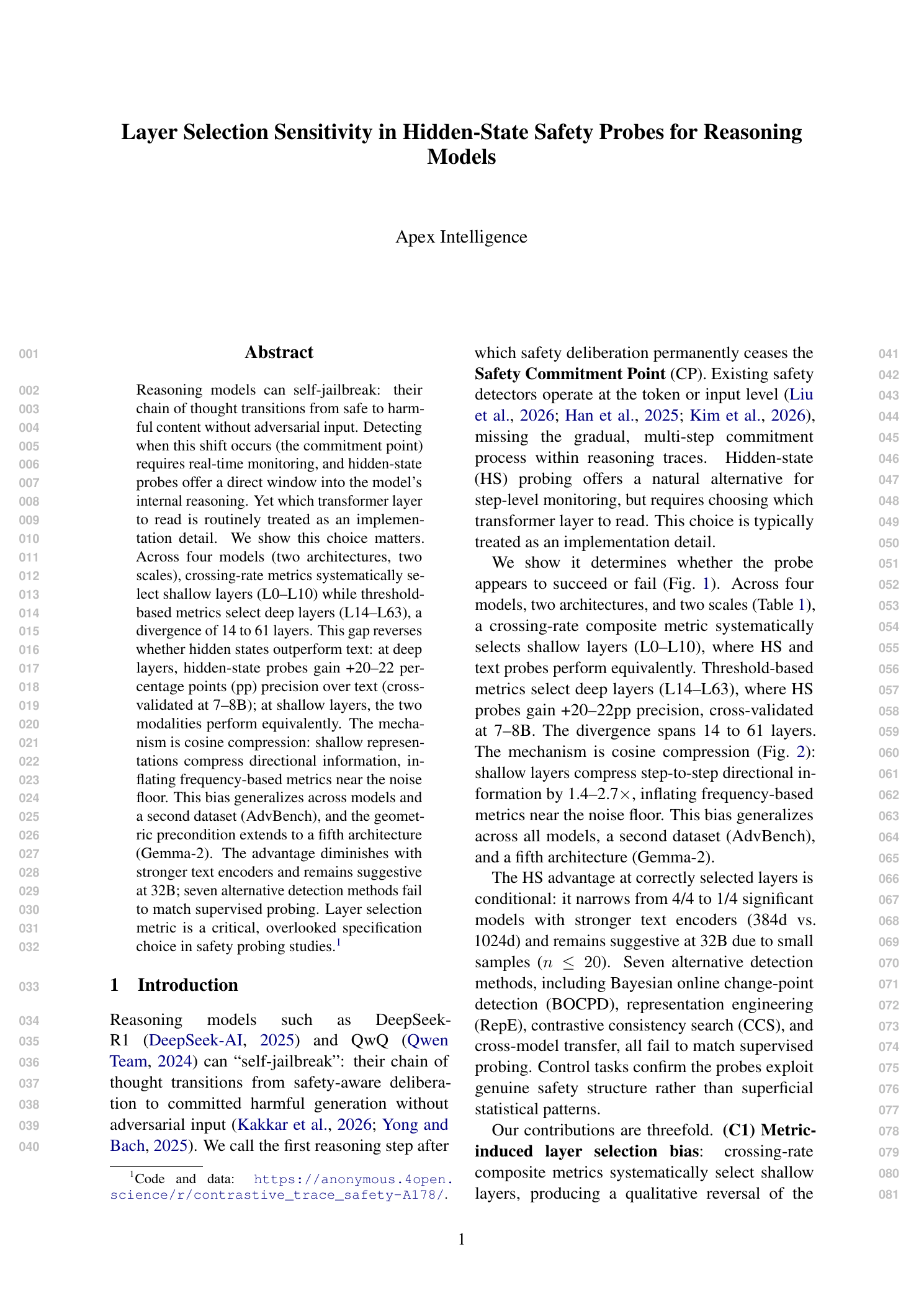
Layer Selection Sensitivity in Hidden-State Safety Probes for Reasoning Models examines how a reasoning model can shift from following safety constraints to producing harmful content during a long chain of thought. Hidden-state probes offer a way to detect that transition before it appears in the final answer, but every probe must first choose which Transformer layer to monitor.
The study treats layer selection as a methodological variable rather than an implementation detail. Across four reasoning models, it compares threshold-crossing frequency, precision, balanced accuracy, and false-positive rate while tracking safety-state representations throughout the network.
The metrics disagree systematically: threshold-crossing measures tend to favor shallow layers (L0–L10), while detection-performance measures favor deep layers (L14–L63), creating gaps of 14–61 layers. At appropriately selected deep layers, hidden-state probes in 7B–8B models improve precision by about 20–22 percentage points over text probes.
The analysis links misleading shallow-layer choices to Cosine Compression, where directional differences between adjacent reasoning-step representations are compressed by roughly 1.4–2.7×. The bias is also tested across models and on AdvBench. Results for the 32B model remain limited by sample size, and the hidden-state advantage still depends on the model and text-encoder configuration.
Read paper PDF ↗Explore project materials ↗
03 · Separating VLA training effects from pretraining priors
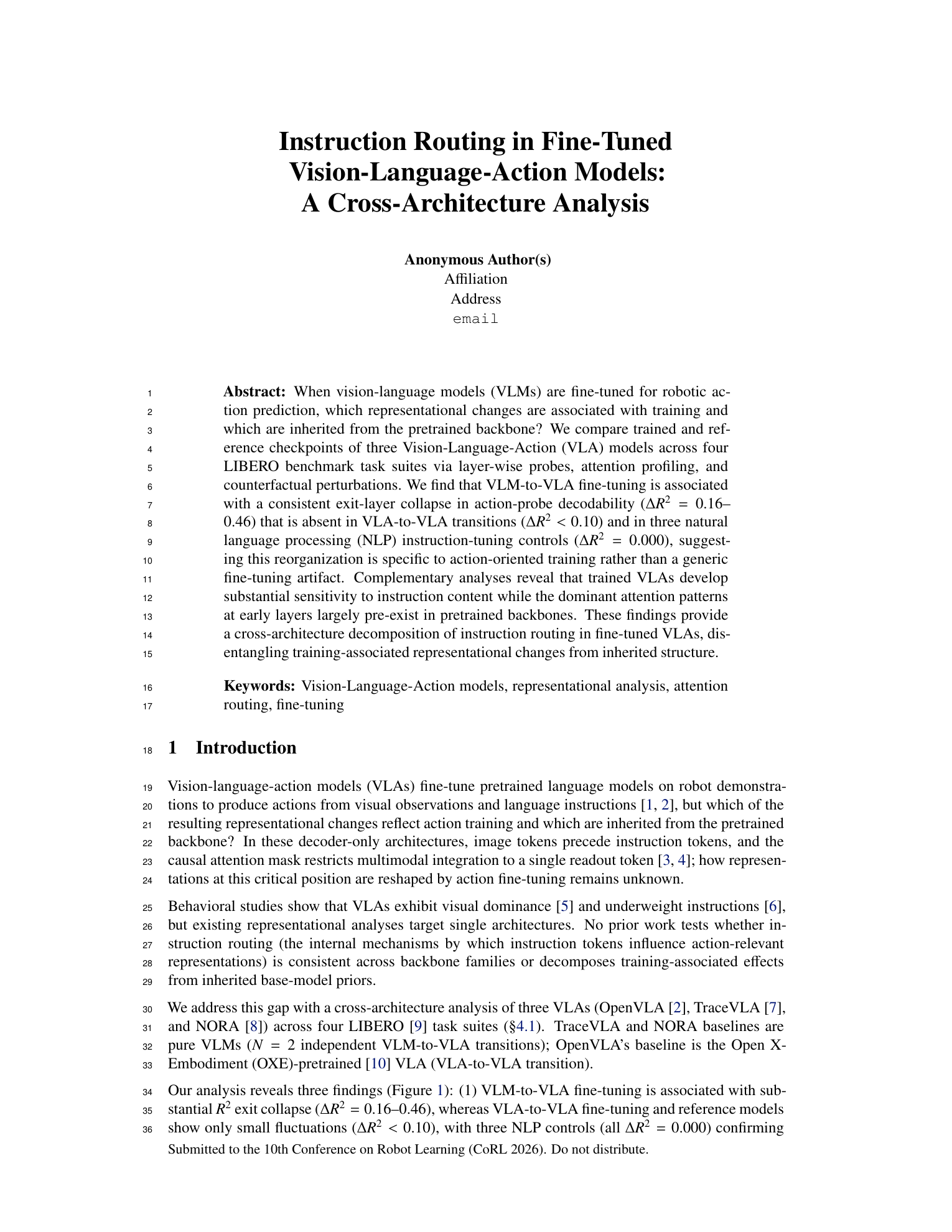
Instruction Routing in Fine-Tuned Vision-Language-Action Models: A Cross-Architecture Analysis asks whether the instruction-processing behavior of Vision-Language-Action models is created by robot action training or inherited from the pretrained vision-language backbone.
The study compares OpenVLA, TraceVLA, and NORA with reference checkpoints across four LIBERO task categories. TraceVLA and NORA reveal VLM-to-VLA transitions, while OpenVLA is used to examine additional fine-tuning on top of an existing VLA. The analysis combines layer-wise probing, counterfactual instruction perturbation, and attention profiling.
For the two VLM-to-VLA transitions, action-information decodability near output layers drops by ΔR² = 0.16–0.46 relative to middle layers. The comparable change for VLA-to-VLA fine-tuning remains below 0.10, and no similar pattern appears in ordinary NLP instruction-tuning controls. Counterfactual instructions produce medium-to-large representation changes (Cohen’s d = 0.45–1.52).
The cross-architecture comparison also shows that some shallow instruction-attention patterns already exist in the pretrained model rather than being newly created by action fine-tuning. This separates action-training-related changes from inherited structures and provides a basis for representation diagnostics and training design. The results are based mainly on open-loop experiments; closed-loop robot evaluation is still needed.
Read paper PDF ↗Explore project materials ↗
04 · Goodhart effects in neurosymbolic reasoning
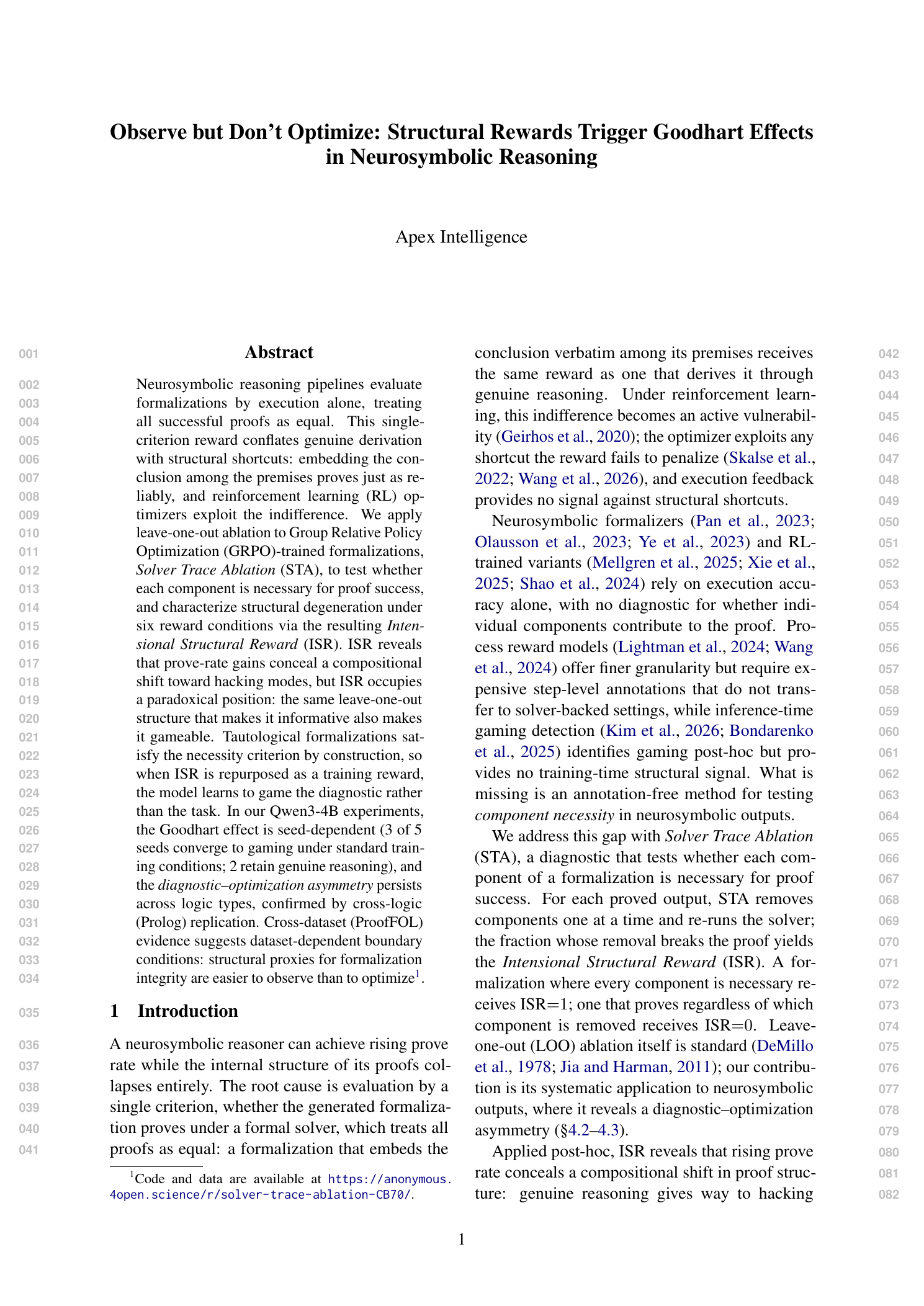
Observe but Don’t Optimize: Structural Rewards Trigger Goodhart Effects in Neurosymbolic Reasoning studies a structural weakness in neurosymbolic training: a model can pass symbolic verification without carrying out a genuine derivation, for example by embedding the target conclusion in the premises or constructing a tautology.
The paper introduces Solver Trace Ablation (STA). It removes generated premises or proof components one by one, reruns the symbolic solver, and checks whether each component is necessary. From this process it derives the Intensional Structural Reward (ISR), a diagnostic score that does not require human step-by-step reasoning annotations.
Using Qwen3-4B with GRPO, the study evaluates first-order logic, Prolog, cross-dataset transfer, and multiple reward settings. When execution success alone is optimized, proof success can exceed 90% while non-speculative proofs fall below 6.2%, showing that formal verification can improve even as the model increasingly relies on shortcuts.
ISR can also be gamed when it is turned from a diagnostic into a direct reward: three of five random-seed runs show the Goodhart effect. The result moves reward-hacking analysis from final outputs into proof composition and highlights a critical boundary—metrics that are useful for observing reasoning quality are not automatically safe optimization targets.
Read paper PDF ↗Explore project materials ↗
05 · Budgeting for reproducible LLM evaluation
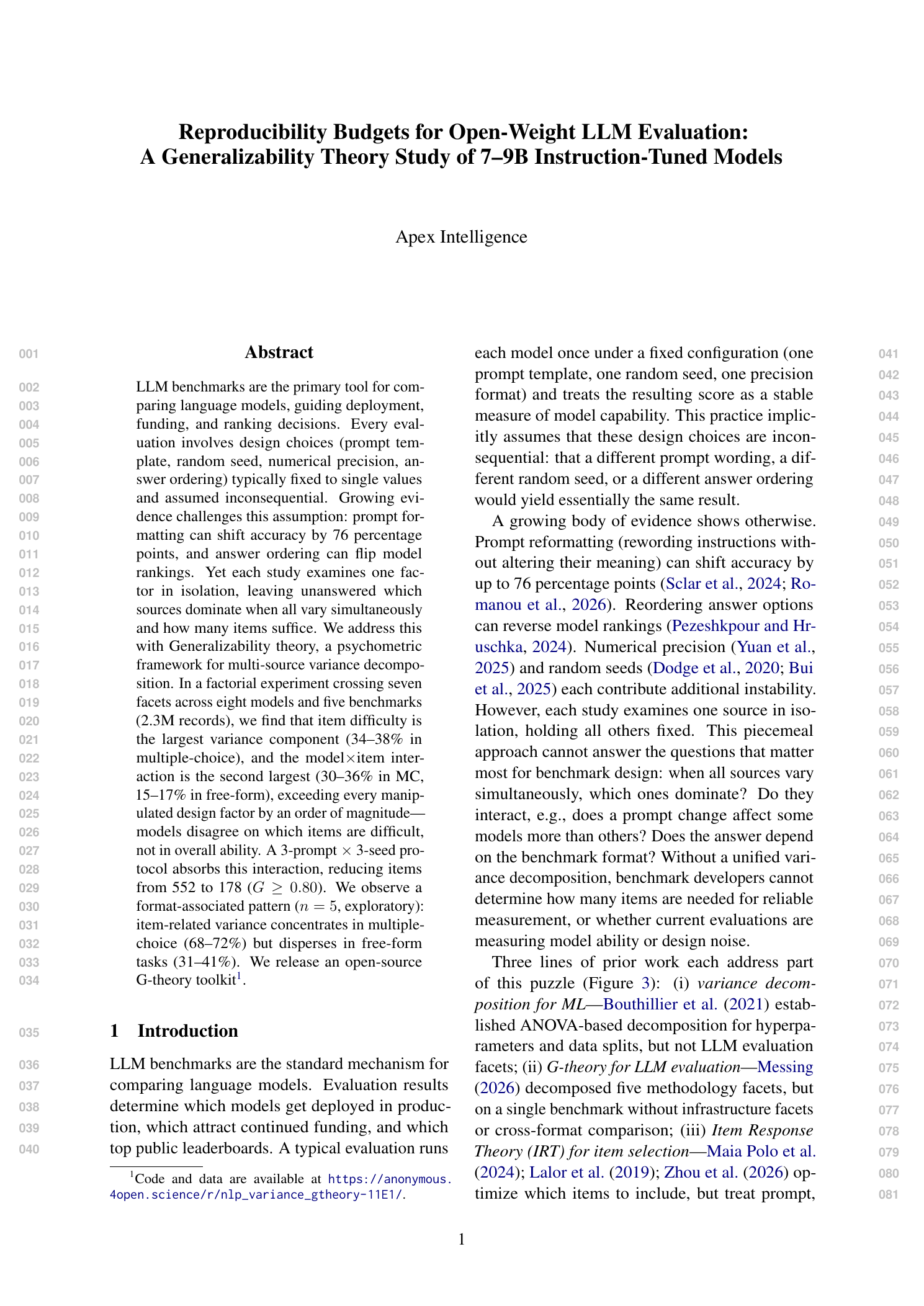
Reproducibility Budgets for Open-Weight LLM Evaluation: A Generalizability Theory Study of 7–9B Instruction-Tuned Models addresses a practical weakness in benchmark reporting: a single score can change with prompts, random seeds, numerical precision, option order, and interactions among those factors.
The study brings Generalizability Theory from psychometrics into LLM evaluation. A G-study decomposes the sources of variance, while a D-study estimates how many items and repeated configurations are required to reach a target reliability. The analysis covers eight open-weight 7–9B instruction-tuned models, five benchmarks, seven classes of evaluation factors, and approximately 2.3 million evaluation records.
Across multiple-choice benchmarks, item difficulty explains approximately 34%–38% of variance, while model–item interaction explains approximately 30%–36%. Both effects are substantially larger than the isolated effects of prompts, seeds, precision, or answer ordering, showing that models differ not only in average performance but also in how they respond to particular items.
The framework turns variance analysis into an evaluation budget. On MMLU, with a target generalizability coefficient of G ≥ 0.80, using three prompts and three random seeds reduces the required number of independent items from 552 to 178. This provides a concrete method for trading repeated configurations against dataset size while preserving reliable model comparisons.
Read paper PDF ↗Explore project materials ↗
Open materials, not papers alone
The complete release is available in the Apex AutoResearch Papers repository. Each result is organized to expose the research process as well as the final manuscript:
- 01-manuscript: paper text, LaTeX sources, and manuscript materials.
- 02-code/source: method implementation, training, and inference code.
- 03-experiments/source: configurations, run scripts, result records, and figures.
- 04-generation-trace: records from task kickoff through paper production.
- 05-validation/source: checking scripts, validation, and review materials.
- 06-maintenance/source: version updates, revisions, and maintenance records.
- 07-index: navigation and cross-references across the release.
Invitation to reproduce, review, and extend
Apex Intelligence welcomes researchers who want to reproduce the experiments, review the methods and claims, or build follow-up work that extends—or refutes—the findings. Independent scrutiny is part of the release model: research becomes more valuable when its evidence can be checked and its conclusions can be improved by the community. Researchers can also join the Apex Intelligence Discord community to discuss the release.
- Reproducers: run the code, review the experiments, and identify anything that cannot be reproduced.
- Reviewers: assess the methods, experimental design, evidence, and rigor of the conclusions.
- Follow-up researchers: extend the results, test them in new settings, or produce evidence that refutes the conclusions.
The value of AI-driven research lies not only in generating papers, but in producing knowledge that can be tested, accumulated, challenged, and advanced by the research community.